
Analytical Testing
Peptide Purity vs. Content: What a COA Actually Measures
Oct
Analytical testing
A purity percentage and a vial-content result answer different questions. Here is how to read them together.
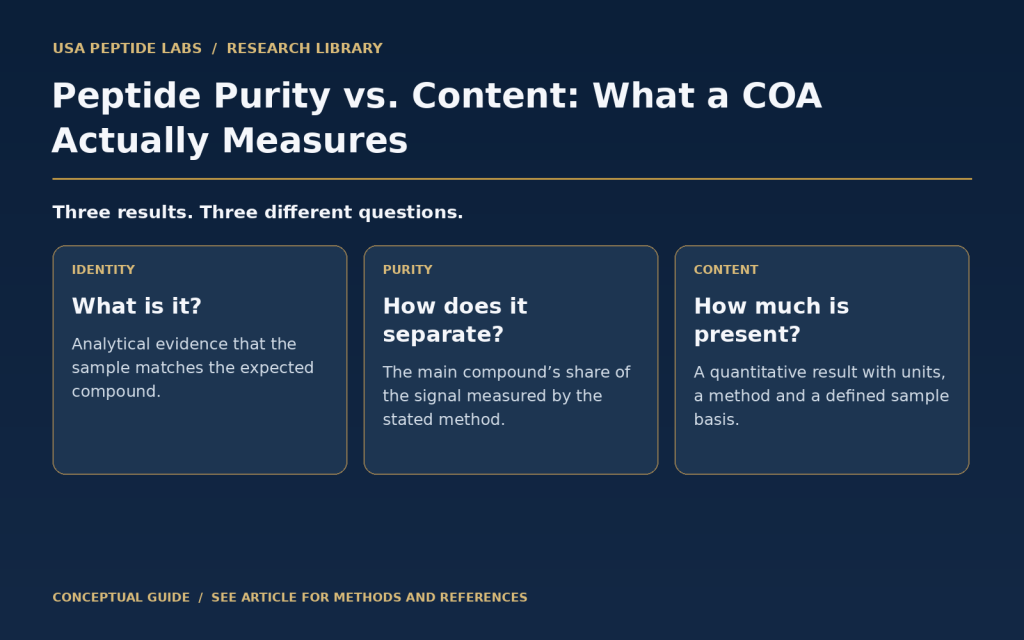
Three results. Three different questions.
A useful number needs a useful definition
A peptide certificate of analysis can report a purity percentage, a molecular-mass result and an amount in milligrams. Those results are complementary. Understanding which question each one answers makes the document more useful when comparing research materials or planning an experiment.
The quickest way to read a COA is to look beyond the headline percentage. Start with the sample name and report date, identify the method beside each result, and check whether the result refers to a tested vial, a bulk sample or another defined preparation. The result should be interpreted on that stated basis.
Purity describes the analytical profile
Chromatographic purity describes the proportion attributed to the target compound within a particular analytical measurement. For an HPLC area-percentage result, the detector signal is integrated across the peaks included in the calculation. A reported percentage depends on the separation, detector and integration rules used by the laboratory. It is not automatically a percentage of everything in the dry vial by weight.1
This matters because a lyophilized preparation may also contain water, counterions or other nonpeptide material. MilliporeSigma explicitly distinguishes net peptide content from peptide purity. Two preparations with similar chromatographic purity can therefore have different peptide mass fractions.2
Content measures an amount
A quantitative content result addresses the amount present, rather than only the relative appearance of chromatographic peaks. Depending on the measurement, the laboratory may report milligrams per tested vial, concentration in a solution or a mass fraction. These units are not interchangeable.
Peptide quantification may use a calibrated HPLC assay, quantitative nuclear magnetic resonance or amino acid analysis. A NIST study compared these approaches using oxytocin, illustrating why quantitative results should be read with their method and reference-standard basis.3
Ask a practical question: does the number describe the same material and sample basis as the label claim? A bulk-material percentage alone cannot establish the amount filled into each individual vial.
Where identity and potency fit
Identity evidence helps establish that the material is consistent with the intended compound. Mass spectrometry can provide molecular-mass information; sequence-sensitive methods can provide additional structural evidence. NIST’s discussion of amino acid analysis distinguishes quantitative composition measurements from the qualitative information supplied by mass measurement, mapping and sequencing.4
The word potency also deserves attention. Some commercial reports use it to describe a quantitative assay or label-content comparison. In biological testing, potency can instead mean measured biological activity. Read the laboratory’s method and units before deciding what the word means on that report. A milligram result does not, by itself, demonstrate receptor activity in a biological system.5
A simple comparison worksheet
| Result | Look for | Question to ask |
|---|---|---|
| Identity | Named method and expected result | What evidence supports this compound assignment? |
| Purity | Percentage, method and chromatogram when available | What does the percentage include? |
| Content or assay | Numerical value, units and sample basis | Was the tested amount compared with the relevant label claim? |
This worksheet is a reading aid, not an assertion that every COA contains every test. An omitted test remains an unanswered question. Analytical identity, purity and content also do not establish sterility or suitability for every experimental application.
Use the document before comparing the price
A more informed purchase begins with the available documentation. Match the product, ask which lot is currently shipping, and review the actual reported results. If a report is unclear, request an explanation before building an experimental plan around an assumed number.
Our COA reading guide explains the wider document, while the COA library provides a starting point for reviewing available reports. For lot-specific questions, contact USA Peptide Labs.
Sources and further reading
- Waters. Quantitative peptide mapping and detector response.
- MilliporeSigma. Peptide Quick Tips: purity and net peptide content.
- NIST. Comparison of peptide quantification methods using oxytocin.
- NIST. Quantitative amino acid analysis by isotope dilution LC-MS/MS.
- FDA. ICH Q6B: specifications and biological potency terminology.
