
Analytical Testing
HPLC vs. LC-MS: What Each Peptide Test Tells You
Oct
Analytical testing
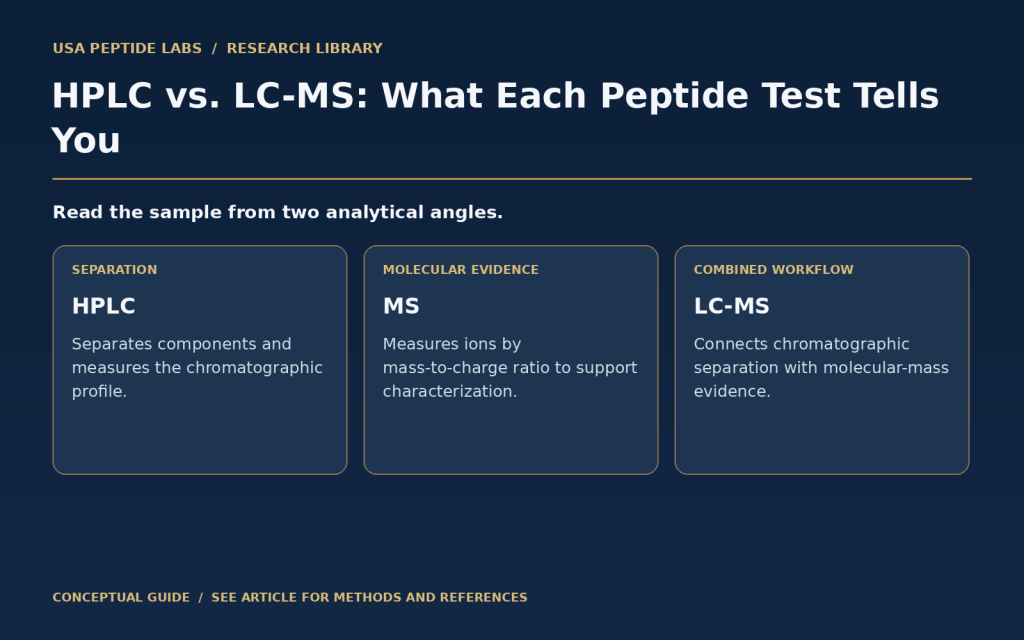
Chromatography separates the sample. Mass spectrometry adds molecular information. Together, they tell a clearer story.
Read the sample from two analytical angles.
Why two methods appear on a peptide report
HPLC and LC-MS are often mentioned together because they answer related analytical questions. HPLC describes a separation method. LC-MS couples liquid chromatography to mass spectrometry. The useful distinction is the evidence each measurement contributes, rather than which acronym sounds more advanced.
When reviewing a report, begin with the stated method and result. A purity percentage, an expected molecular mass and an amount in milligrams should each be supported by the appropriate measurement. One instrument name does not automatically establish all three.
What HPLC contributes
High-performance liquid chromatography separates sample components as they move through a column. A detector records a signal, producing a chromatogram with peaks at different retention times. In peptide analysis, the separation can help distinguish a target compound from related components.
Waters’ peptide-analysis work demonstrates why separation quality, reproducibility and detector response matter when comparing peptide signals. If components are insufficiently resolved, interpretation becomes harder. A percentage without the method offers less context than a percentage accompanied by a readable analytical profile.1
An HPLC area percentage should therefore be understood as a result from that separation and detection method. It does not automatically identify every possible contaminant or establish the amount of peptide filled into a vial.
What mass spectrometry adds
A mass spectrometer measures ions according to their mass-to-charge ratios. Peptides can generate multiple charge states, and the data can be interpreted to estimate molecular mass. Comparing the observed result with the expected mass provides evidence relevant to identity.
Some workflows also examine fragmentation patterns or peptide maps to obtain more detailed structural information. Agilent’s characterization tools distinguish intact-mass analysis, impurity assessment and sequencing, which are different analytical tasks rather than interchangeable labels.2
An intact-mass match supports a compound assignment, but it need not resolve every sequence or structural question. The confidence of the conclusion depends on the evidence actually collected and the specificity of the method.
How the combined workflow helps
LC-MS connects the separated components with molecular information. A laboratory can examine a chromatographic feature and assess the mass-related evidence associated with it. That complementary view can support characterization of both the target peptide and related components.
NIST describes mass measurements, peptide mapping and tandem-mass-spectrometry sequencing as sources of qualitative information, while amino acid analysis can support quantitative concentration assignments. This is a useful reminder to distinguish characterization from quantification.3
Questions the report should make easier to answer
| Question | Evidence to review |
|---|---|
| How was purity calculated? | The chromatographic method, detector and reported percentage basis. |
| Does the sample fit the expected compound? | Mass or structural evidence and the laboratory’s stated identity conclusion. |
| How much material was measured? | A quantitative assay, units, reference basis and defined sample. |
| Can I connect this document to the product? | Product name, sample or lot identifier, laboratory and report date. |
Peptide quantification is its own measurement problem. A NIST comparison evaluated calibrated HPLC, quantitative NMR and amino acid analysis for an oxytocin material. That work supports reading quantitative values alongside the actual procedure rather than assuming any LC-MS label proves vial content.4
Choose clarity over a testing badge
A testing badge is a useful invitation to inspect the underlying report. The document should tell you what was analyzed and what the laboratory concluded. If it gives only a percentage, ask what identity and quantitative evidence are available separately.
Start with the USA Peptide Labs COA library and our guide to reading a COA. When a research plan depends on a particular analytical requirement, ask about the current lot and available documentation before ordering.
For a closer look at what a percentage or milligram result means, read Peptide Purity vs. Content.
Sources and further reading
