
Research Literature
CJC-1295 No DAC and Ipamorelin: Why These Peptides Are Paired
Oct
Peptide blends · Endocrine research
CJC-1295 No DAC and Ipamorelin are paired in research because they approach growth hormone signaling through different receptor pathways. One is a GHRH analog; the other is a growth hormone secretagogue. Understanding that distinction—and what “No DAC” means—explains why this combination attracts interest in endocrine research.
USA Peptide Labs Research Library · October 6, 2026
Two signals, different entry points
Growth hormone-releasing hormone, usually abbreviated GHRH, participates in the regulation of growth hormone secretion through its own receptor. CJC-1295 No DAC belongs to the GHRH-analog side of this research: its role in the pairing is to engage that receptor pathway.
A 2020 structural study by Zhou and colleagues examined the human GHRH receptor in an activated complex using cryo-electron microscopy. It helped describe how GHRH recognition relates to receptor activation. The study provides a molecular view of the pathway, rather than an experiment on a commercial CJC/Ipamorelin blend.1
What Ipamorelin contributes
Ipamorelin is a five-amino-acid growth hormone secretagogue. The term secretagogue describes a compound that stimulates secretion; it does not mean the material is growth hormone itself. Its research interest comes from a receptor route distinct from GHRH signaling.
In a 1998 paper, Raun and colleagues evaluated Ipamorelin in rat pituitary cells and animal experiments. Antagonist studies supported a GHRP-like receptor mechanism. The investigators also examined endocrine selectivity, including ACTH and cortisol responses in swine under the tested conditions.2 Those findings help explain Ipamorelin’s place in secretagogue research. They should be read within the experiment’s model and endpoints.
Why the pairing is scientifically interesting
The rationale is complementary signaling: two compounds associated with different receptor entry points can be examined within the same endocrine research framework. That creates questions about how the pathways interact, how the response changes over time, and whether combining the materials changes a measured endpoint compared with either component alone.
Complementary mechanisms are a reason to investigate a combination, not proof of synergy. Demonstrating synergy requires a defined comparison and measurements showing the combined response exceeds the appropriate expected response. A mechanistic explanation alone cannot establish that a particular blend has produced that result.
| Component | Research pathway | What distinguishes it |
|---|---|---|
| CJC-1295 No DAC | GHRH-receptor signaling | GHRH analog without the DAC albumin-binding modification |
| Ipamorelin | Growth hormone secretagogue pathway | Pentapeptide studied through a receptor route distinct from GHRH |
| The blend | A two-pathway research question | Combination effects need their own experimental evaluation |
DAC and No DAC are different research materials
DAC means Drug Affinity Complex. The albumin-binding modification is central to the long-acting form’s design. Jetté and colleagues’ 2005 work examined albumin bioconjugates and identified an extended-duration GHRH analog.3 A subsequent human study by Teichman and colleagues investigated a long-acting CJC-1295 formulation.4
A listing labeled No DAC identifies material without that DAC modification. The FDA’s chemical review also distinguishes CJC-1295 and CJC-1295 DAC as different active moieties.5 Consequently, multiday pharmacokinetic findings from the long-acting DAC literature should not be transferred to a No DAC product. Neither those papers nor a shared name establishes the duration of a finished No DAC/Ipamorelin blend.
Read the product name as carefully as the paper
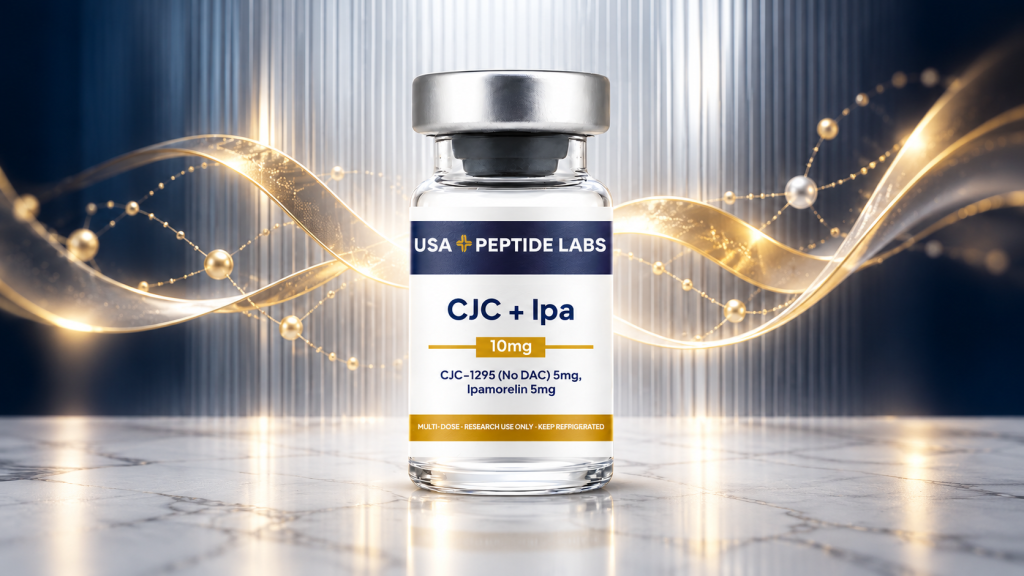
Start a comparison by identifying the CJC form, the other component, and the amount of each. A “10 mg blend” describes a total; it does not necessarily mean 10 mg of each peptide. The USA Peptide Labs CJC/Ipamorelin listing specifies 5 mg of CJC-1295 No DAC plus 5 mg of Ipamorelin.
For the broader analytical questions behind a blend, see peptide purity vs. content and the HPLC vs. LC-MS guide. These explain why identity, purity and component amount answer different questions.
Frequently asked questions
Are CJC-1295 No DAC and Ipamorelin the same type of peptide?
No. CJC-1295 No DAC is a GHRH analog, while Ipamorelin is a growth hormone secretagogue with a different receptor mechanism.
Does a blend automatically mean proven synergy?
No. The pairing has a mechanistic rationale, but synergy is a measured experimental result that requires suitable component and combination comparisons.
Can a CJC-1295 DAC study describe the No DAC blend?
It can provide background on related research, but the DAC modification changes the material. Formulation-specific duration and response findings cannot be assumed to apply across the two forms.
Sources and further reading
- Zhou et al. Structural basis for activation of the growth hormone-releasing hormone receptor. Nature Communications, 2020.
- Raun et al. Ipamorelin, the first selective growth hormone secretagogue. European Journal of Endocrinology, 1998.
- Jetté et al. hGRF(1–29)-albumin bioconjugates and a long-lasting analog. Endocrinology, 2005.
- Teichman et al. Investigation of long-acting CJC-1295 in healthy adults. Journal of Clinical Endocrinology & Metabolism, 2006.
- FDA. CJC-1295-related substances: chemical distinctions. Pharmacy Compounding Advisory Committee briefing document, 2024.
Educational overview of peptide research. Research materials are intended for laboratory and analytical work; this article does not provide a human-use protocol.
