
Research Literature
MOTS-c Research: A Mitochondrial Peptide and Cellular Stress Signaling
Oct
Research literature
MOTS-c helped expand the scientific view of mitochondria from energy production to communication between cellular compartments.
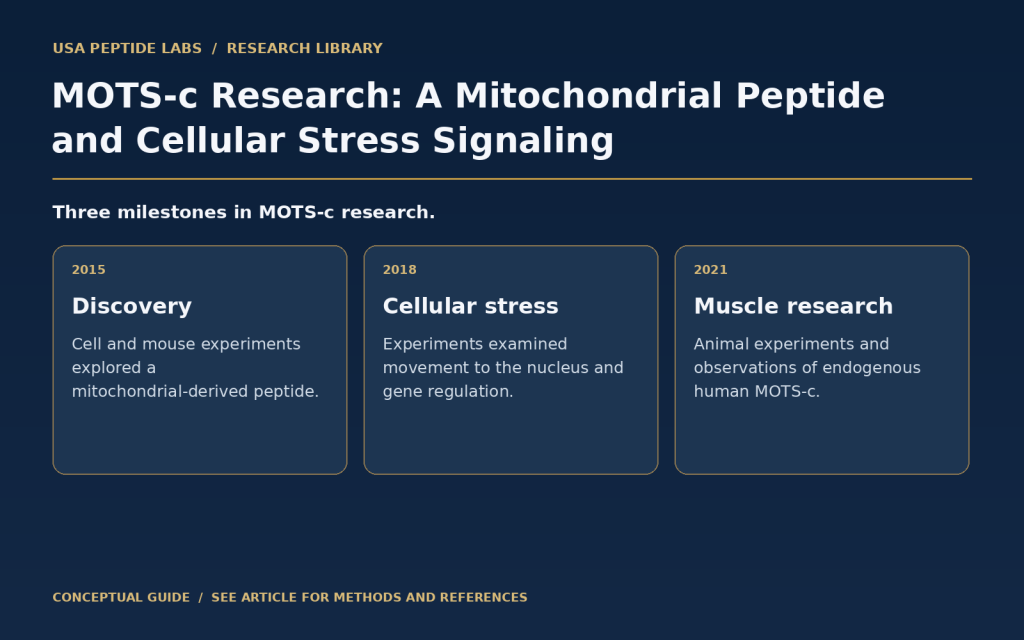
Three milestones in MOTS-c research.
Why MOTS-c is scientifically interesting
Mitochondria are familiar as cellular energy-producing structures. MOTS-c research adds another dimension: small peptides encoded within the mitochondrial genome can participate in cellular communication. That makes the compound relevant to questions about how a cell senses and responds to changing conditions.
The most useful way to explore this literature is to follow the experiments. Which system was studied? What did researchers measure? What question does the result answer? Those details provide a clearer picture than broad claims about energy or longevity.
The discovery paper
A 2015 study by Lee and colleagues described MOTS-c as a 16-amino-acid mitochondrial-derived peptide associated with a short open reading frame within mitochondrial 12S rRNA. The authors used cell experiments and mouse models to investigate relationships with metabolic regulation and AMPK-linked signaling.1
That paper helped establish MOTS-c as a subject for mechanistic investigation. Its significance lies in the proposed signaling role and the experimental observations, rather than in a claim that any research vial produces a particular outcome in a person.
A connection between mitochondria and the nucleus
Kim and colleagues extended the story in 2018. In the cellular models studied, MOTS-c moved to the nucleus during metabolic stress and participated in changes in nuclear gene expression. The response was described as AMPK dependent.2
This gives researchers a defined set of questions: how localization changes under different conditions, which gene-expression patterns accompany that change, and which parts of the response depend on particular signaling pathways. The molecule is interesting because those questions can be examined experimentally.
What the exercise paper actually compared
A 2021 study by Reynolds and colleagues combined animal experiments with human observations. The human portion examined exercise-associated changes in endogenous MOTS-c in skeletal muscle and circulation. The animal portion investigated administered MOTS-c in controlled experimental models.3
Those are different forms of evidence. Observing a naturally occurring peptide after exercise is not the same as demonstrating what externally supplied material does in humans. Keeping the study arms separate preserves the useful finding without making the conclusion larger than the experiment.
Read the evidence by model
| Study | Model or evidence | Useful research question |
|---|---|---|
| Lee et al., 2015 | Cells and mice | How is MOTS-c linked to cellular metabolic regulation? |
| Kim et al., 2018 | Cellular stress experiments | How does localization relate to nuclear gene regulation? |
| Reynolds et al., 2021 | Animal experiments and endogenous human observations | How do muscle and circulating measurements change across the studied conditions? |
The table is a reading map of these papers, not a ranking of products or a claim about clinical effectiveness. Model, endpoint and experimental conditions remain part of every conclusion.
From an interesting paper to a reproducible project
For a laboratory purchasing research material, literature and analytical documentation serve different roles. The papers inform the scientific question. Product documentation helps assess the identity and characteristics of the material selected for that work.
A practical review can start with the sequence or compound specification, the available identity and purity results, the sample or lot identifier and the study’s analytical needs. Additional assays may be necessary depending on the experiment. A COA should be read for what it reports, rather than treated as proof of every property a project might require.
The MOTS-c product page provides the current catalog listing and available documentation. For help locating a report, use the COA library or ask our support team about the current lot.
Sources and further reading
