
Research Literature
Retatrutide vs Tirzepatide: Understanding Dual and Triple Receptor Agonists
Oct
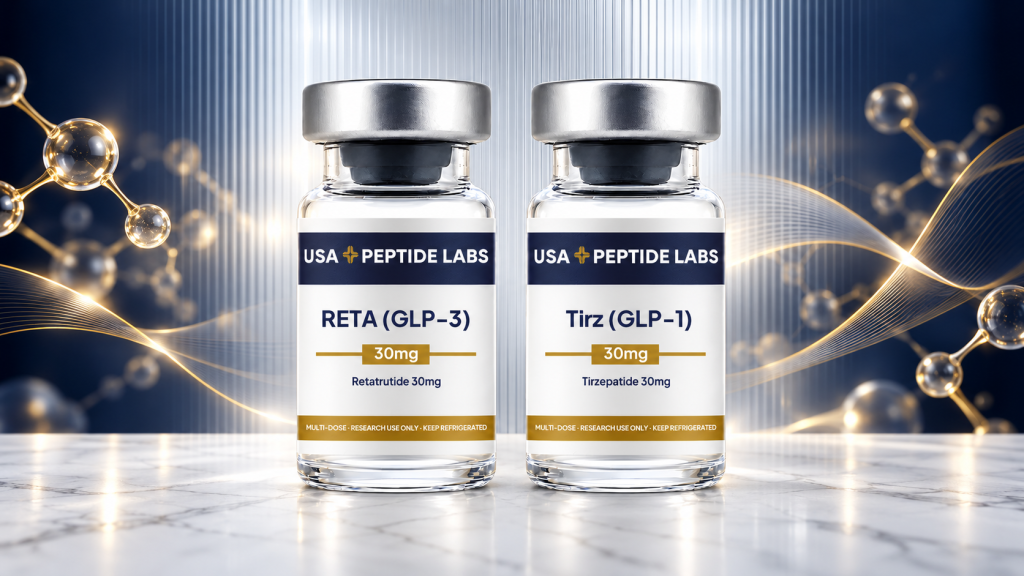
Retatrutide and tirzepatide are often grouped together in conversations about metabolic peptides, but their receptor profiles are different. Tirzepatide engages two hormone receptors: GIP and GLP-1. Retatrutide engages those same receptor families and adds the glucagon receptor. Understanding that distinction makes it easier to follow the research and see why a dual agonist and a triple agonist answer different scientific questions.
What does receptor agonist mean?
A receptor is a molecular structure that receives a signal. An agonist activates that receptor, initiating a response that researchers can measure. In this context, dual and triple describe the receptor targets a compound engages; they do not describe how many separate ingredients are mixed together.
Both compounds are engineered peptides with activity at more than one receptor. Their scientific interest comes from bringing multiple signaling pathways into one molecular design.
Retatrutide vs. tirzepatide at a glance
| Receptor target | Tirzepatide | Retatrutide |
|---|---|---|
| GIP receptor (GIPR) | Agonist activity | Agonist activity |
| GLP-1 receptor (GLP-1R) | Agonist activity | Agonist activity |
| Glucagon receptor (GCGR) | Not part of its dual-agonist profile | Agonist activity |
| Research classification | Dual receptor agonist | Triple receptor agonist |
This table summarizes receptor targets, not comparative potency or a ranking of outcomes.1,2
Tirzepatide: combining two incretin pathways
Tirzepatide, identified in early publications as LY3298176, combines GIP-receptor and GLP-1-receptor activity. GIP and GLP-1 belong to the incretin system, which connects nutrient intake with glucose-dependent insulin signaling.
In the 2018 discovery paper, Coskun and colleagues examined receptor signaling in cells, metabolic responses in mice, and early clinical development. The receptor experiments established that one peptide could engage both targets.1 For mechanistic research, this creates an opportunity to examine how two related signals interact instead of studying GLP-1 activity alone.
Retatrutide: adding glucagon-receptor activity
Retatrutide, initially described as LY3437943, extends the multi-receptor approach to GCGR. This addition introduces another metabolic pathway alongside the GIP and GLP-1 receptor components.
The 2022 discovery paper characterized activity at all three receptors. Its mouse experiments examined the contribution of glucagon-receptor signaling to energy expenditure within the broader metabolic response.2 Those findings give the triple-agonist architecture a specific research rationale. They do not establish that any commercially supplied research vial will reproduce a clinical outcome.
Why three targets do not automatically mean “better”
Counting receptors is only the beginning of a comparison. A useful research question also considers the biological model, the endpoint being measured, and the conditions under which the experiment runs.
For example, a receptor-signaling assay asks a different question from a whole-animal metabolism experiment. The first may isolate activity at a particular receptor; the second includes interactions among tissues and signaling systems. Neither result should be stretched beyond what was measured.
Three questions that make the comparison useful
Which pathway is the project designed to examine?
Start with the scientific question. Is the emphasis on dual incretin signaling, or does the experiment specifically investigate the contribution of glucagon-receptor activation?
What is being compared?
Check whether the paper compares compounds within the same experiment. Results from separate studies can differ because of their methods, models, or endpoints. A comparison of receptor profiles is not a direct comparison of treatment outcomes.
What material and measurements does the method require?
Compound identity, experimental concentration, and assay suitability belong in the planning stage. Use the product specification alongside the original methods rather than assuming that materials with related names are interchangeable. Our guide to reading a peptide COA explains the analytical terminology.
Frequently asked questions
Is Retatrutide simply a stronger Tirzepatide?
That description oversimplifies the difference. Retatrutide has a distinct triple-receptor profile, including GCGR activity. Strength depends on the measurement and cannot be inferred from the number of targets.
Are GLP-1 and glucagon the same thing?
No. Their names are related, but GLP-1R and GCGR are different receptors. That distinction is central to understanding why Retatrutide is classified as a triple agonist.
Does this article recommend personal use?
No. This comparison explains research terminology and receptor profiles. USA Peptide Labs supplies laboratory research materials; this article does not provide dosing, treatment, or personal-use instructions.
Primary sources
- Coskun et al. Tirzepatide (LY3298176) discovery and receptor characterization. Molecular Metabolism, 2018. DOI: 10.1016/j.molmet.2018.09.009.
- Coskun et al. Retatrutide (LY3437943) discovery and triple-receptor characterization. Cell Metabolism, 2022. DOI: 10.1016/j.cmet.2022.07.013.
