
Research Literature
MOTS-C vs. SS-31: Two Approaches to Mitochondrial Research
Oct
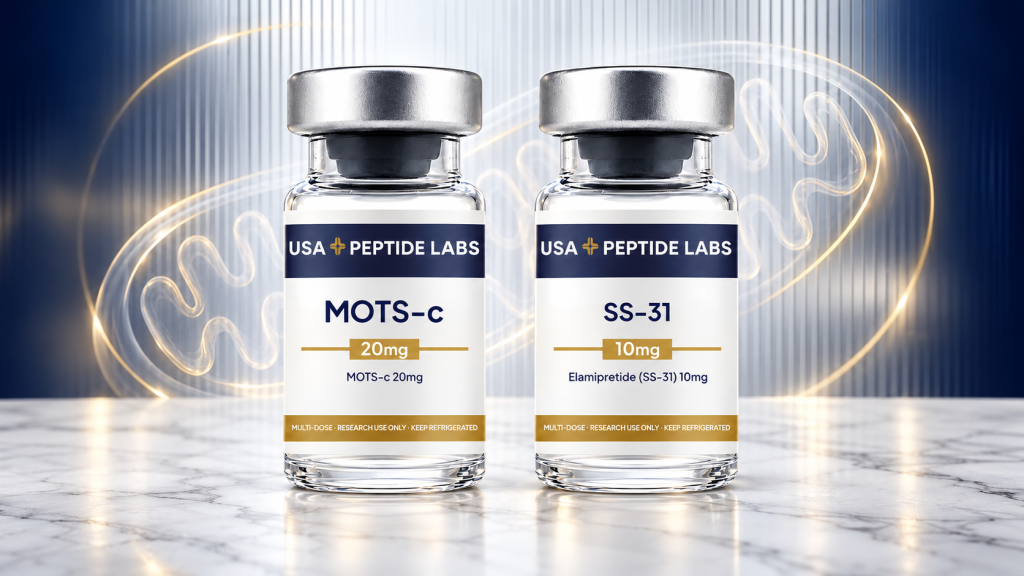
MOTS-C and SS-31 both appear in mitochondrial peptide research, but they address different biological questions. MOTS-C is studied as a metabolic signaling peptide, while SS-31 is investigated for its interaction with cardiolipin in the mitochondrial inner membrane. Understanding that difference makes it easier to compare the literature and identify which research material fits a specific laboratory question.
MOTS-C vs. SS-31 at a glance
| Comparison | MOTS-C | SS-31 |
|---|---|---|
| Peptide type | 16-amino-acid mitochondrial-derived peptide | Synthetic four-amino-acid peptide |
| Research emphasis | Metabolic signaling and cellular energy responses | Cardiolipin interactions and inner-membrane biology |
| Representative measurements | AMPK signaling and metabolic changes | Membrane structure, respiration, and oxidative processes |
| Key distinction | Signals associated with metabolic adaptation | Interactions associated with mitochondrial membrane function |
What MOTS-C research examines
MOTS-C belongs to the mitochondrial-derived peptide family: its sequence is encoded within a small region of mitochondrial DNA. Lee and colleagues reported changes in folate-related metabolism and purine synthesis that were associated with activation of AMPK, a cellular energy-sensing pathway. Their experiments included cultured cells and mouse models.
This gives MOTS-C research a signaling emphasis. A study might ask whether a metabolic stress changes the response to MOTS-C, or whether a particular pathway is necessary for an observed effect. For its broader background, see our existing MOTS-C research overview. This comparison focuses on how its research questions differ from those surrounding SS-31.
What SS-31 research examines
SS-31, also known as elamipretide, is a synthetic tetrapeptide. In experiments reported by Birk and colleagues, SS-31 interacted with cardiolipin, a phospholipid associated with the mitochondrial inner membrane. The investigators examined cardiolipin–cytochrome c interactions, oxidative activity, and mitochondrial structure in experimental systems that included a rat kidney ischemia model.
That work places the emphasis on membrane biology and bioenergetics. It differs from asking how a mitochondrial-derived signaling peptide changes cellular metabolism. The phrase “mitochondrial peptide” therefore describes a shared area of interest, rather than one mechanism shared by both compounds.
Compare the research question before comparing results
A useful comparison starts with the measurement. An increase in a signaling marker and a change in mitochondrial membrane structure are different observations. Neither automatically tells a researcher that one compound is universally “better.”
When reading two papers side by side, check four details: the cell or animal model, the conditions used to create stress, the time point of measurement, and the endpoint. A difference between papers may reflect those choices rather than an intrinsic ranking of the peptides. This is especially important when one paper measures a pathway marker and another measures respiration or morphology.
A head-to-head experiment also needs its own justification. Combining results from separate publications does not establish that combining the compounds produces an additive or synergistic effect. That is a separate question requiring direct evidence.
Frequently asked questions
Are MOTS-C and SS-31 interchangeable?
No. Their structures and research mechanisms differ. Choose the material around the biological question and assay rather than the shared mitochondrial label.
Is research-grade SS-31 the same as an approved medicine?
No. The FDA granted accelerated approval to Forzinity, an elamipretide injection, for a specific Barth syndrome indication in 2025. That approval applies to the approved drug product and indication; it does not make research-grade SS-31 vials equivalent to that medicine.
Where should I start if I am comparing both?
Start with the original studies below, identify the endpoint you need to understand, and then compare the corresponding product details. Our Research Library includes separate guides to handling peptides and interpreting analytical reports.
Primary sources
- Lee et al., 2015, Cell Metabolism: original MOTS-C metabolic signaling study.
- Birk et al., 2013, Journal of the American Society of Nephrology: SS-31, cardiolipin, and mitochondrial function.
- FDA, 2025: accelerated approval announcement for Forzinity.
This article explains published research. USA Peptide Labs products are supplied for laboratory and analytical research.
