
Research Literature
BPC-157 vs. TB-500: What Research Actually Compares
Oct
BPC-157 and TB-500 often appear together in conversations about soft-tissue research, including the pairing commonly called the Wolverine stack. They are different peptides, however, and comparing them means looking beyond that shared nickname. Their molecular identities, experimental models, and measured outcomes matter. This guide explains where the research overlaps, where it differs, and why thymosin beta-4 findings need careful interpretation when discussing TB-500.
Start with the molecule, not the nickname
BPC-157 is a 15-amino-acid peptide. TB-500 requires a more specific explanation: the name is often discussed alongside thymosin beta-4, but a product name alone does not establish that two research materials have the same sequence.
Full-length thymosin beta-4 contains 43 amino acids. A 2012 analytical study by Esposito and colleagues identified the acetylated seven-amino-acid fragment Ac-LKKTETQ in the TB-500 formulation it examined. That finding identifies that particular material; it does not make every product bearing the name interchangeable with full-length thymosin beta-4.
What the BPC-157 tendon research measured
In a 2011 study by Chang and colleagues, researchers examined rat Achilles tendon explants and cultured tendon fibroblasts. They measured tissue outgrowth, cell survival under oxidative stress, movement, and spreading. The study also investigated FAK and paxillin, proteins involved in cell adhesion and movement.
Several of these outcomes increased under the experimental conditions, while the proliferation assay did not show a direct increase in fibroblast proliferation. That distinction is useful: cell movement, survival, and multiplication describe different processes. The findings concern specific laboratory models, rather than a demonstration that BPC-157 produces the same result in every tissue or in people.
What thymosin beta-4 and fragment studies measured
Thymosin beta-4 research includes actin-related biology and tissue-response models. Actin is part of the cell’s structural machinery, and a 1993 study by Hannappel and Wartenberg examined how full-length thymosin beta-4 and selected fragments differed in an actin assay. The fragments did not all reproduce the parent peptide’s behavior.
In a 2003 study by Philp and colleagues, full-length thymosin beta-4 was evaluated in diabetic and aged mouse skin-wound models. The researchers measured outcomes including wound contraction, collagen deposition, and keratinocyte movement. A synthetic LKKTETQ fragment was also investigated in aged animals.
These results help explain interest in this peptide family. They do not erase the differences between the full-length molecule, an unacetylated fragment, and an acetylated fragment sold under a different name.
BPC-157 vs. TB-500 at a glance
| Comparison | BPC-157 | TB-500 discussion |
|---|---|---|
| Molecular starting point | 15-amino-acid peptide | Confirm the sequence and modifications; distinguish fragments from full-length thymosin beta-4. |
| Example research model | Rat tendon explants and fibroblasts | Thymosin beta-4 and LKKTETQ studies in mouse skin models |
| Comparison limit | Different experiments do not establish which compound is better, or whether a combination is synergistic. | |
Where the Wolverine stack and KLOW fit
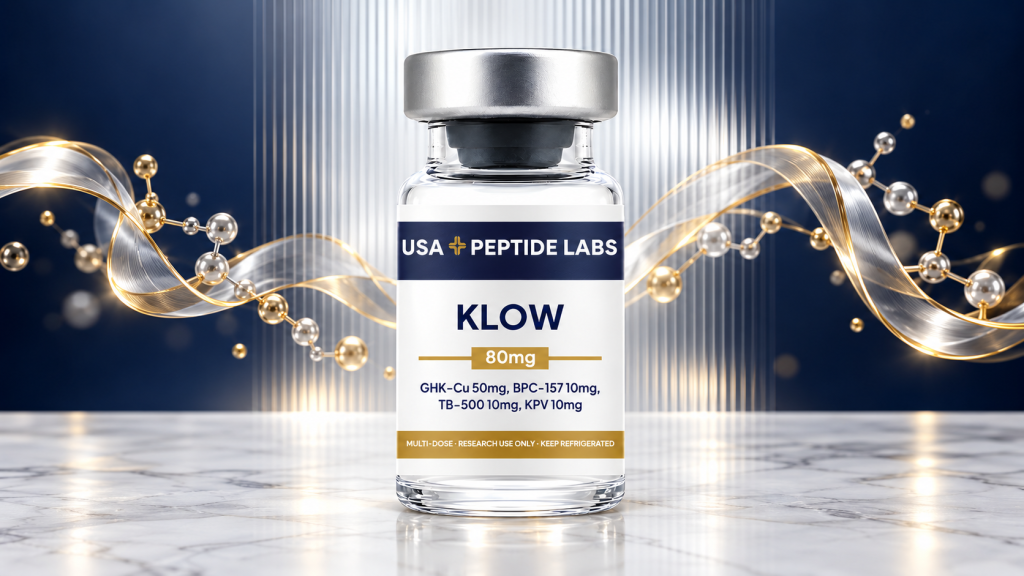
The Wolverine nickname describes a BPC-157 and TB-500 pairing; it is not the name of a standardized clinical result. KLOW expands that pairing with GHK-Cu and KPV. A blend provides a different experimental composition from either single peptide, and its effects need to be evaluated as a blend. Separate ingredient studies cannot establish that combining those ingredients adds their effects together.
For another part of that research picture, explore our Research Library for GHK-Cu and other compound guides.
How to read a comparison without losing the context
Ask three questions before treating two study headlines as a comparison:
- What was tested? Match the sequence and chemical modifications, rather than relying on a shortened name.
- What was the model? A tendon-cell experiment and a mouse skin-wound experiment answer different questions.
- What was measured? Cell migration, collagen deposition, and tissue-level outcomes are related research interests, but they are not interchangeable measurements.
Frequently asked questions
Is TB-500 the same as thymosin beta-4?
Do not assume equivalence from the name. Check whether the material is the full 43-amino-acid peptide or a particular fragment, including any modifications.
Does this research show BPC-157 is better than TB-500?
No. The examples above use different materials, models, and endpoints. They are not a head-to-head ranking.
Do ingredient studies prove a blend works the same way?
No. They can inform a research question, but a combination requires its own experimental evaluation.
This article discusses experimental research and does not provide dosing or treatment guidance.
